Background, classification of noise categories and use.
Noise charges –an incentive for less noise
Noise category classification
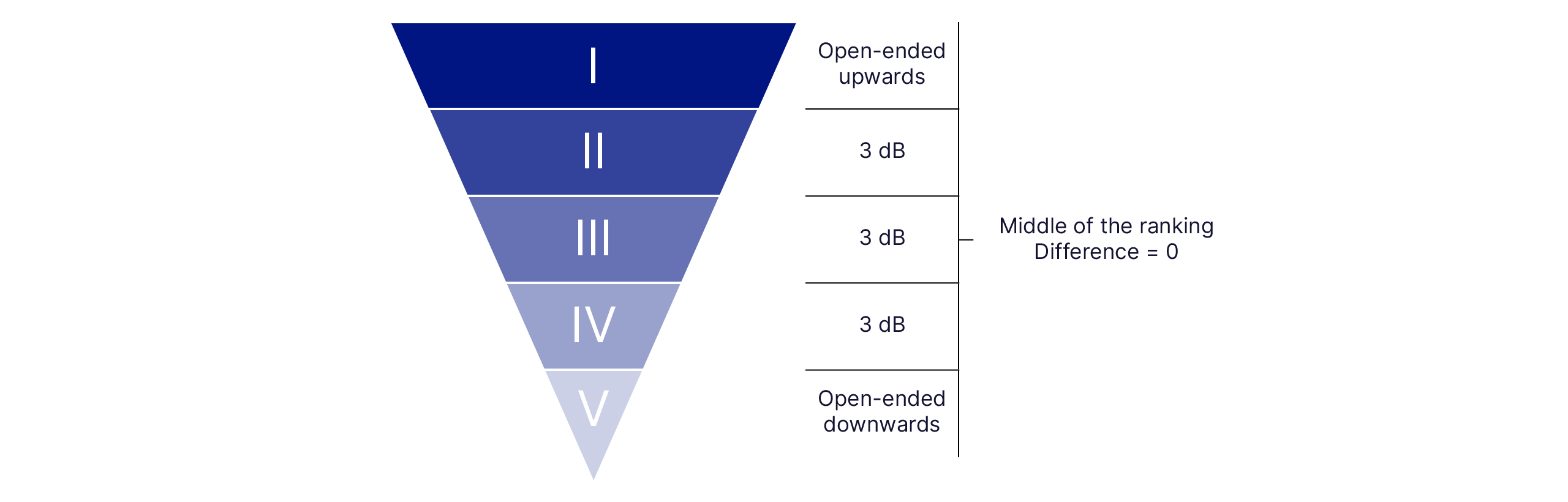
The noise charge model specifies that each aircraft is assigned to one of five noise categories based on noise measurements. Category I includes the noisiest aircraft types, while category V includes the quietest. Not all aircraft types take off from the same runway and can be measured at the same monitoring point; the following measurement locations are relevant for noise category classification:
| Runway | Use | NMT |
| Departure 28 | Short- and medium haul flights and business jets | 1 (Rümlang) |
| Departure 16 | Long haul flights during daytime | 6 (Opfikon) |
| Departure 32 & 34 | Long haul flights in the evening/night | 3 (Oberglatt) |
To compensate for factors such as the aircraft’s distance to the NMT, weather conditions or take off weight, an average value is calculated for each take off direction and NMT across all aircraft. Each aircraft type is then compared with this average.
The overall average across all aircraft types and take off directions corresponds to the centre of noise category III. Each category spans 3 dB; noise category I is open at the top, and noise category V is open at the bottom.
By averaging across all aircraft types, any shift toward quieter aircraft is automatically reflected. Over recent years, the average value for take offs on runways 16 and 28 has steadily decreased.
Noise categories and night-time noise charges
Noise categories
Noise category I includes the loudest aircraft types, while category V contains the quietest. The noise charge increases with each noise category and ranges from CHF 0 (category V) up to CHF 2,000 (category I).
Night-time noise charges
Do you have any questions?
The staff of the Aircraft Noise Hotline will be happy to help you.